Friday, October 19, 2007

Solar Decathlon Winner Today

Its been quite a race this week!

Today at 2pm EDT, the winner of the 2007 Solar Decathlon will be announced.

Five of the top seven teams are within 25 points of each other (out of 1,000) The final competition "Engineering" worth 150 points remains.

The University of Maryland has dominated the scoring since the first day but Santa Clara Universtity with a slow start at 18th place has climbed eleven places to within 13 points of the top five. The final competition puts everone within reach of first place.
NOTE: Santa Clara's strategy will work best if the last day of the competition is cloudy. So check live webcam of the Solar Decathlon villiage above for cloudiness.

The last day of scoring can be viewed here.

Good luck to each of the twenty groundbreaking teams!

Wednesday, October 17, 2007

Cast a Giant Circle

Drawing a circle around a company's environmental footprint is tricky. Does it end at the front desk? or should the circle include the downstream consequences and benefits as well?

Many companies produce intelligent products and services that enable millions to reduce their energy consumption. In the process, their employees may drive cars to work and their data centers may glow like the Sun.

But if the products they produce reduce their customer's own driving (Ebay) or the new version of their product consumes far less power than last year's model (Intel), the result can be factories that save more energy than they consume in the full global context.

Once the purview of avid environmentalists, the cause for conservation is being taken over by the market. Conservation and Clean Tech is good business. People are now saving energy because it saves money.

There was a time when conservation was a major concession to operational effectiveness and only a niche product feature. But today, Clean Tech solutions hit every component of the bottom line.

Clean Tech materials are lightweight, durable and because of their design for sustainability are less susceptible to supply interruptions. A lower power product upgrade can actually pay for itself in energy savings. A company may not even stake claim to "Cleanness" in its promotion. Clean Tech based products are simply better products.

An update of the old saw might be well heeded by those who would protest the drivers of the new Clean Economy:
You have to spend energy in order to save energy.

Sunday, October 14, 2007

Solar Decathlon Underway

Today, October 14, 2007, is the third day of the Solar Decathlon competition in Washington DC. (Live scores for each team can be seen here.) Twenty university teams from around the world are exercising their undergraduate designed, ultra energy efficient homes for the judges in hopes to take home first prize. At the same time, the teams together are achieving collective success in attracting much deserved attention to the state of the art for residential Clean Tech.

The technical achievements of these teams are staggering. But it must be remembered that these are young undergraduate engineers grappling with their first exposure to real world problems.

The Santa Clara University Team is no exception.

For the past year, the project has grown in complexity. The team's ranks have bloomed to include more than a hundred students and corporate sponsors ranging from Silicon Valley start-ups to the Fortune 500. By September, the home was built and the competition strategy was planned. All that remained was it disassemble the house, ship it to Washington DC and reassemble it.

The Santa Clara Team is an underdog. It was the 21st ranked applicant to 20 slots. Only when one team dropped out did Santa Clara become an entrant. It is the smallest University accepted to the competition and the only University without an architecture school to be accepted. It also has the farthest shipping distance to Washington DC. (The international teams assembled their houses in nearby Maryland.)

The shipping distance, it turned out, was a big deal. Undergraduate projects typically involve displaying your project beside the podium as you give your final presentation. They do not typically involve the transcontinental wide-load version of Murphy's Law.

The truck transporting the house had breakdowns en route: twice. The first before it was out of sight of Santa Clara University. This breakdown required the students to drive to Sacramento for parts followed by pre-dawn welding before the house was at last on its way.

Then, the day before it was due to arrive, news came that the truck had broken down again -in Nebraska. The students had to phone truck repair shops to arrange after-hours service.
When the US Secretary of Energy Samuel Bodman visited the team, the house was still hours away. At last, on October 5th, with only a week until the competition began, the house arrived to the cheers of every Solar Decathlon team.
Wisely, the students had used their extra wait time to lay out in minute detail their construction plan. It is telling that although the Santa Clara house was the last one to arrive, it was one of the first to successfully pass inspection.

Now the competition is underway. The Solar Decathlon website is reporting team standing and scores updated every fifteen minutes. The winner and final scores will be announced on Friday, October 20th.

We're rooting to Santa Clara to perform well in its representation of the West Coast of the United States, but all of the teams are making history this week. Give them your support.

Don't let anyone you know who can visit the competition miss out on this unique opportunity to see the future. The 2007 Solar Decathlon teams are the first graduating class of the Solar Century.

Monday, September 24, 2007

The 2007 Solar Decathlon

This past Sunday (9/23/07), Santa Clara University, a rising star in clean tech, shipped its entry to the International Solar Decathlon Competition to be held on the Mall in Washington DC from October 12 –20, 2007. As the sole successful entry from the West Coast of the United States, their entry represents not only the “greenest” part of our country, but the best example of the vast unreleased potential of our next generation’s focus on renewable energy.
The Solar Decathlon is a competition sponsored by the US Department of Energy bringing together twenty international university undergraduate teams to design, build, and operate the most attractive, effective, and energy-efficient solar-powered houses in the world. This is no science project. You might expect such an effort to result in odd looking unconventional structures typical of “house of the future” exercises, but the scoring criteria of the Solar Decathlon specifically reward entries that are livable, practical and economical as well as innovative and energy efficient.

A tour through Santa Clara's 650 sqft. interior and equally spacious outdoor deck presents an impression comparable to a high-end newlywed apartment. Meticulous attention to interior design elements make the inside bright and friendly with an open feeling that affords both privacy and accessibility. Woven into the livable layout are an endless matrix of innovations in design for efficiency.

As the name would suggest, the foundation of the Solar Decathlon home is the gathering of solar energy. So appropriately, the roof blossoms with solar electric and solar thermal collectors. Solar electric energy is either used or stored in an economical battery array while solar thermal heated water is used for hot water and also cold water and air thanks to the first residential application of solar-hot-water-powered air conditioning.

Walk up the decks and step inside to be greeted by a showcase of attractive and functional renewable materials. The walls around you are insulated with material made from recycled denim. Kitchen and bathroom tiles are made from recycled glass. The cabinets and flooring are made of easy to grow and highly renewable bamboo. Look up and you will see the first code-compliant load bearing bamboo beams in North America. Every corner of the home has a design element story that is practical today.

Remind yourself that this entire project including engineering, design, logistics, and even publicity is executed by undergraduate students. To see the energy unleashed in these students toward the goal of green building design practices is to see the future. Their goal is not to simply earn course credit. They want to show the world how this can actually be done. Santa Clara’s entry is but one of twenty in the competition. It mirrors the commitment and enthusiasm of the Class of ’08 around the World.

If you can arrange the opportunity, visit the Washington Mall in October to see the Solar Decathlon competition and immerse yourself in a preview of the excitement that will characterize this solar century.

Monday, July 2, 2007

The Solar Century


One hundred years ago, the world was at the threshold of a new era. All of the airplanes in the world wouldn’t have filled a schoolyard. Of the few automobiles there were, they were as likely to be powered by electricity as by gasoline. The land speed record was held by a steam powered car. Oil was mainly used for heating and lamplight. The industrial age had begun, but radical change was ahead. The tapping of the Spindletop oilfield had recently tripled US oil production overnight.

Citizens of 1907 could never have dreamed of the explosive growth that abundant cheap oil would cause for not only the already robust oil industry itself, but the enabled growth of every other sector of the economy due to cheap oil. For a hundred years, the economy has flourished and matured.

But the gift of oil will not last forever. For thirty years, its production and discovery rate have been in decline and at the same time, society has realized the myriad of externalities that burden its gift. Not only is oil the major contributor to air pollution, but in the long term, it is more precious as the raw material for pharmaceuticals, pesticides and other organic chemical products. As Terry Shoup, President of ASME pointed out in a keynote talk in May, “Oil is a better used as a lubricant than it as a fuel.” Future generations will resent us not only for putting pollution into the skies, but for wasting a precious resource in order to do so.

We therefore stand at a rare point of convergence. Just as we have acquired a distaste for petroleum fuel and its recently high price –we have in our grasp an array of new technologies that light the path from petroleum energy. We have the will and the ability. As Dick Swanson of SunPower suggested to a Harvard Business School symposium on Solar Energy in January, “In the last century, we built up the fossil fuel industry. This century will definitely be when we wind it down.”

The public’s demand for clean, distributed energy will only grow. New technologies that are available today will deploy as rapidly as factories can be built. And perhaps most promising of all, the next generation will only add to the energetic insistence that we follow this path.

We stand on the shoulders of all that came before us, but future generations will celebrate that this millennium began with the Solar Century.

Monday, April 2, 2007

Gold from the Blue Sky(tm)

Today's solar boom has been developing slowly and methodically over the past three decades. Many individuals and companies have been quietly preparing for the commercial acceptance that is finally at hand. These wise men are crafting their dreams into reality.

Unfortunately, the kind of transition to acceptance they envisioned will never come. What will come is something completely different.

The Lesson
Imagine that, in 1847, the US Government decided to populate California. Their sensible heads would have suggested a careful plan involving the preplacement of law enforcement, schools and local government services. Along with that, they might have put in place plans to insure the suitable housing and churches were waiting the new settlers. Doctors, engineers, lawyers and teachers would be encouraged to make the trip. The increased flow of settlers could have been optimistically estimated to be a healthy, sustainable few hundreds per year. All very sensible and reasonable.

But those plans, if laid, were superseded when the prospect of gold entered the equation. Tales of instant wealth and rivers flowing with gold spread across the world, inspiring tens of thousands from every walk of life to abandon normal lives and productive work. They crossed the oceans and crossed the continent knowing that all of their party might not survive the trip. They arrived at boom towns ill suited to feed and clothe the would-be miners, let alone protect any resulting property. But still they came. Over four years, a hundred thousand gold-seekers found their way against all odds (and all economic sense) to seek gold.

Gold Fever is a primitive and irresistible force. People will do wild and unlikely things that sensible heads would never predict to find "gold". Laws laid down beforehand may not be regarded as binding.

But from this chaos, prosperity did eventually come. A quick minded few made fortunes selling picks, shovels, food and clothing to the gold seekers. In time, order was restored.

The Present
With the age of economic solar energy upon us, there will be talk of "Gold from the Blue Sky"(tm). Its a claim worthy of the of California Gold Rush hyperbole. Only this time it is true:

Converted into its cash equivalent, solar energy falls on your rooftop like a light rain of pennies, gathering about $25 every daylight hour.

So prepare for another Gold Rush. But this time the masses won't just be coming to California. They will be entering the solar business in every corner of the global market. Over the past year, some wise heads have suggested moderation in forecasting this new industry. They remind us that it takes time to build proper factories, supply chains and customer awareness. With confident certainty, they point out that the supply of silicon itself is currently constrained and all incumbent members of the supply chain worldwide are operating at capacity. Some of the most likely companies to successfully enter the solar arena (experts in semiconductor manufacturing such as IBM, Intel and TSMC) are only just starting to explore the issue -if at all. The wise heads are justified in their assurance of moderation. It would seem that even hitting a mere 20% solar target by 2020 is could be overly ambitious.

But Gold Rushes are full of surprises.

The valiant incumbents of the solar industry will enjoy a brief surge of success as customer adoption explodes. However, their decades of momentum with conventional approaches to this business will be surpassed by new entrants who will have no problem rewriting the rules. Just as bank tellers and farmers walked across burning deserts to become gold miners, wild-eyed companies and investors with no prior experience or interest in solar (or Green) will hurl themselves into the mix. Without pre-existing notions of fair play or a sense of community, the new entrants will write their own rules. They will do unexpected things, bringing practices from their native business environments. (How will a Chinese towel manufacturer behave on the solar playing field?) They will innovate in unconventional ways. The status quo will be left behind.

As the solar gold rush begins, the giant solar incumbents such a Sharp are making more money than they ever have before. While they celebrate their long sought success, new companies such a SunPower (with its record holding high efficiency cells), and Miasole (who aspires to develop an entire new material technology for solar), will soon pass the incumbents in the marketplace.

Consider the story of LDK Solar. In January of 2005, just as the industry was warning that supply constraints would cap growth to just 5% for 2006, LDK Solar was founded in China by by a man living in the United States. He had no experience with semiconductor technology or manufacturing. He had no preconceptions. LDK found a growth-positive community with no manufacturing employment base that sought to participate in the new solar industry. Thus, LDK enjoyed a motivated permitting process measured in days rather than years and a school system that would redirect itself to training workers for LDKs enormous factory. Founded in 2005, LDK went from an empty field field to an NYSE IPO (It was too large for NASDAQ.) on June 4, 2007 with a market cap of $4B. LDKs capacity is sold out sold through 2009.

This has all happened before, but never before has the pattern been so recognizable in advance. The same forces that have always conspired against incumbents are still in place. Sharp and Kyocera could invest substantial R&D into CIGS based cells and use their operational effectiveness to squash Silicon Valley upstarts. For that matter, a Petroleum Energy such as Exxon could tap its record profits of late and simply acquire the top contenders in every segment of solar. But they won't, and even if the incumbents try to keep up, the upstarts will simply move faster, changing the game in the quest for gold.

One hard to accept lesson from Gold Rushes of the past is the greatest fortunes were not made from finding gold at all, but from the selling of picks and shovels.

Perhaps this time the fortune winner will the happy consumer, whistling cheerfully as he farms pennies from his roof every sunny day.

Friday, March 2, 2007

The Sure Things and The Hail Mary

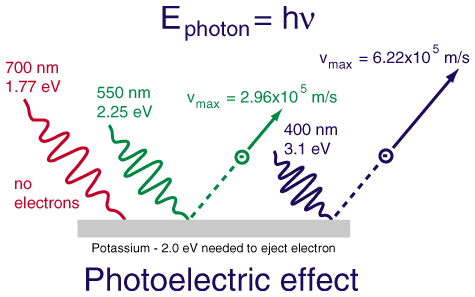
Albert Einstein's photoelectric effect (PV) is the process by which the photons in sunlight are converted into electricity. It is the reverse process that is observed in familiar LED lights. The materials which exhibit this effect are small band gap semiconductors.

There are (currently) four major technical approaches to photovoltaic generation of electricity. Each has an proportional balance of advantages and risks. Each approach is a combination of light gathering (how much sunlight is collected per unit area of a cell), PV conversion efficiency (how much electricity is generated per area of sunlight) and cost (Dollars per Watt of energy produced by the cell).

Each is well represented in Silicon Valley today.


Crystalline Silicon (Ex.: SunPower)
This is a sure thing. Based on the same traditional crystalline silicon that is used in electronics, crystalline silicon solar cells have the advantage of being using extremely well understood physics as well as high volume manufacturing practices. There are literally tens of thousands of industry seasoned experts on this material in the electronics industry. This results in an early advantage in unit cost and manufacturing scalability. Crystalline silicon offers high photoelectric conversion efficiency, but is very complex and expensive to produce. Crystalline silicon cells are actually made from the "waste" wafers that are unusable for electronics.

However, Even with these seeming advantages, crystalline silicon is very complex to manufacture and after forty years of cost reduction, it is a fair concern that flat plate silicon solar cells should not expect many more major cost reductions. (or should we? watch for a future blog..)


The Bottom Line: This is what you see on rooftops today. Nearly all solar cells in existence to day are crystalline silicon based cells. Today they are less expensive than other exotic approaches, but it may be difficult to reduce cost further.

Light Gathering: 1 Sun
PV Conversion Efficiency: 15-18%
Current cost per Watt: $4.80


Amorphous Silicon Thin Film (Ex.
Applied Materials)
Amorphous simply means non-crystalline. Also comprised of familiar silicon, this is a sure thing as well. Because it lacks the delicate crystal lattice structure of crystalline silicon, it is much less expensive to produce (imagine filling a sandbox with sand versus building a house of cards). For the same reason, its PV conversion efficiency is also lower -but not proportionally. Amorphous silicon based solar cells must be larger in order to generate the same amount of power, but the resulting cost will be lower. Amorphous silicon also benefits from incumbent status: It is the material used in LCD displays of which ten square miles will be produced in 2007.

However, while industry experience reducing the cost of amorphous silicon is not as mature as that of crystalline silicon, it has already seen cost fall by 20x. There is certainly still room for improvement, but the bottom of the well may not be far off.

The Bottom Line: Amorphous silicon is slightly less efficient at converting sunlight into electricity but much less expensive to produce. While the physics and manufacturing issues surrounding amorphous silicon are well enough understood that it can be produced in volume today, it is not so well understood that we should not expect further breakthroughs and cost efficiencies. All of the World's expertise with crystalline silicon for electronics can easily be ported to amorphous silicon.

Light Gathering: 1 Sun
PV Conversion Efficiency: 8-12%
Current cost per Watt: $3.99


Concentrated Photovoltaic (Ex.: SolFocus, Silicon Valley Solar)
This starts to be more of a long shot. The Concentrated PV approach addresses the high cost of the semiconductor material by using optics to focus a given area of light onto a small unit area of extremely high efficiency , but still proportionally less expensive compound semiconductor material. For example, by using 500x optical concentration (500 Suns), concentrated PV cell will generate as much electricity with 1 cm2 of semiconductor material as a standard (1 Sun) PV cell would produce with 500 cm2 of semiconductor. The idea is that the reduced cost of semiconductor material required will more than offset the added cost of optics and tracking motors (CPV cells typically must be aligned with precision toward the sun, tracking it across the sky through the day and the seasons)

However, it remains to be seen if the structural and maintenance costs of optics and motors over a twenty year lifetime outdoors will be justified by the accompanying increase in efficiency.

The Bottom Line: The principal of trading mystically delicate and expensive semiconductor material for apparently simple optics and tracking motors is reasonable, but there is a real challenge to the reliability and maintenance costs of anything that sits on a roof for twenty years. No one has been able to make this quite work yet.


Light Gathering: 2 to 500 Suns
PV Conversion Efficiency: 26%
Projected cost per Watt: <$3.00


CIGS Thin Film (Miasole, Nanosolar)
CIGS (Copper, Indium, Gallium, Selenide) is the Hail Mary, the long shot that could win the game. The preceding approaches all struggle with the manufacturing cost of their PV semiconductor material. CIGS approach seeks to reduce the cost of the semiconductor itself. Discovered in 1975, CIGS is a relatively new material, lacking the benefit of an enormous knowledge base of silicon. Despite this humble beginning, CIGS has demonstrated PV efficiency as high as 20% and thanks to a manufacturing process that requires comparatively moderate temperature and pressure control relative to silicon, it promises a dramatic reduction in energy cost. As an added benefit, CIGS PV cells are flexible, allowing cosmetic applications that are not practical with brittle crystalline silicon cells. It also greatly simplifies the demands of the panel structure -further reducing cost.

However, put simply, no one has ever been able to produce CIGS solar cells in high volume despite more than $140M of venture capital invested in Silicon Valley alone. In order to succeed, CIGS companies must develop new material physics, new manufacturing techniques and combine them into high reliability, high volume manufacturing processes. The risk is high, but the reward is its match.

The Bottom Line: CIGS has the best chance of delivering solar electricity at an price that will compete with coal. If CIGS is successful in its ambitions, it will be most important commercial development of this century.

Light Gathering: 1 Sun
PV Conversion Efficiency: up to 20%
Projected cost per Watt: <$1.00


What comes next? There's a very good bet. Watch for a future installment of The Solar Evangelist...